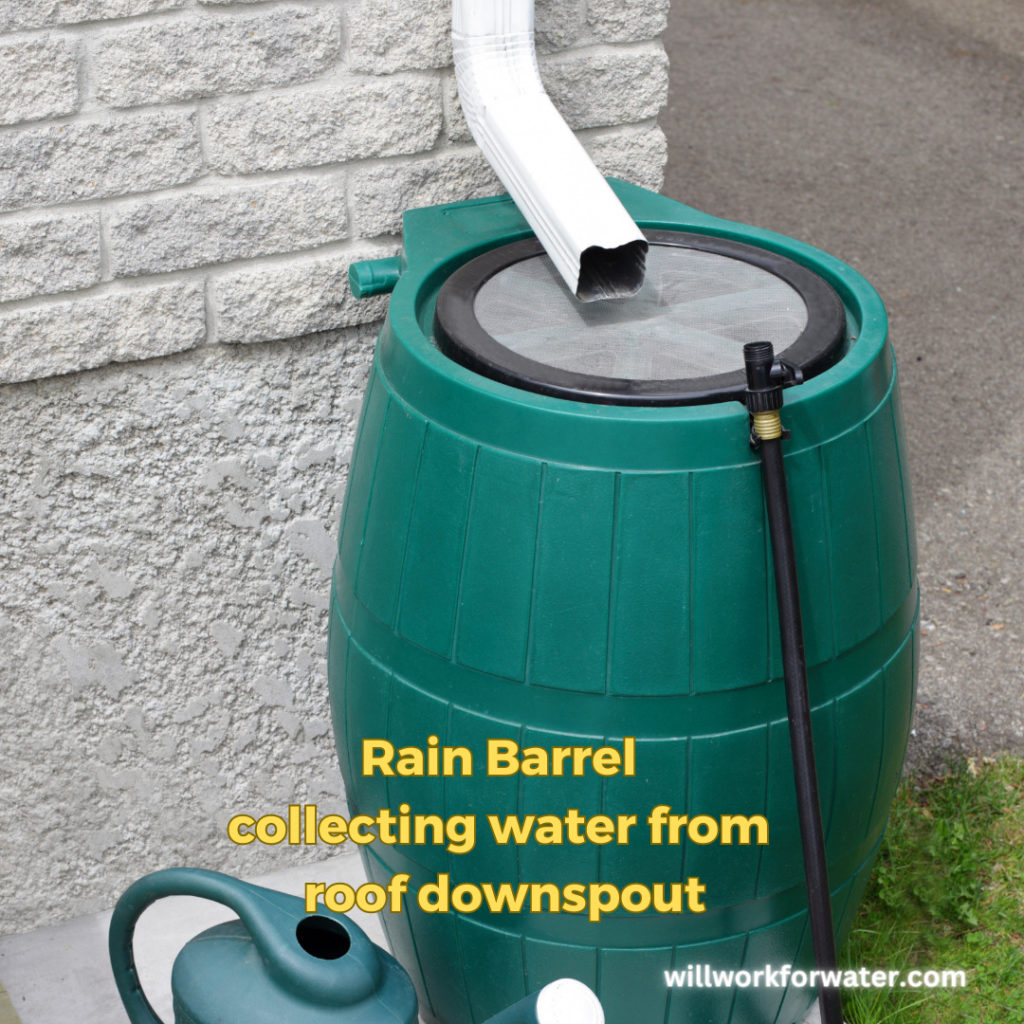
Rainwater harvesting tank sizing starts with a simple question: how much water can the roof collect, and how much storage is useful for the intended demand? A tank that is too small overflows frequently. A tank that is too large may cost more than the amount of water it saves.
Basic rainwater collection formula
A practical screening calculation is:
Collected volume = roof area x rainfall depth / 12 x runoff coefficient
The result is in cubic feet when roof area is in square feet and rainfall depth is in inches. To convert cubic feet to gallons, multiply by 7.48.
You can run this calculation using the Rainwater Harvesting Calculator.
Step 1: Estimate the contributing roof area
Use the horizontal roof projection area that drains to the downspout or gutter connected to the tank. If only one portion of the roof is connected, use that portion instead of the entire roof.
Step 2: Select the rainfall depth
The rainfall depth depends on your design objective. For small residential reuse, you may use a typical storm depth or a monthly rainfall estimate. For stormwater compliance or site design, use the rainfall depth required by the local agency or design standard.
Step 3: Apply a runoff coefficient
Not all rainfall becomes stored water. Losses can occur from wetting, splashing, gutter inefficiency, first flush diversion, and overflow during larger storms. Roof runoff coefficients are often high, but a conservative value can help account for losses.
Step 4: Compare storage with demand
Tank storage is only useful if there is a demand for the water. Typical nonpotable uses include irrigation, hose bib use, toilet flushing where allowed, washdown, and process water where appropriate. The Tank Drawdown Calculator can help estimate how long stored water will last at a given demand rate.
Example calculation
Assume 1,500 square feet of roof area drains to a tank. The design rainfall depth is 1.0 inch and the runoff coefficient is 0.90.
Volume = 1,500 x 1.0 / 12 x 0.90 = 112.5 cubic feet
112.5 cubic feet x 7.48 = about 842 gallons
A 500 gallon tank would capture part of this event and overflow during larger storms. A 1,000 gallon tank would provide more capture capacity, but the final choice should consider available space, cost, plumbing, overflow routing, and actual water demand.
Other tank sizing considerations
- Provide safe overflow routing away from foundations.
- Screen inlets to reduce debris and mosquito issues.
- Consider first flush diversion where water quality is important.
- Check local plumbing, health, and stormwater requirements.
- Provide access for cleaning and maintenance.
Related tools
- Rainwater Harvesting Calculator
- Tank Drawdown Calculator
- Water Engineer Unit Converter
- Water Calculators
Planning a reuse or rainwater system?
Start with the reuse guide, then use calculators for tank sizing, drawdown, pump power, and storage planning.